Rodgers and Hart–Words and Music (Biopic)
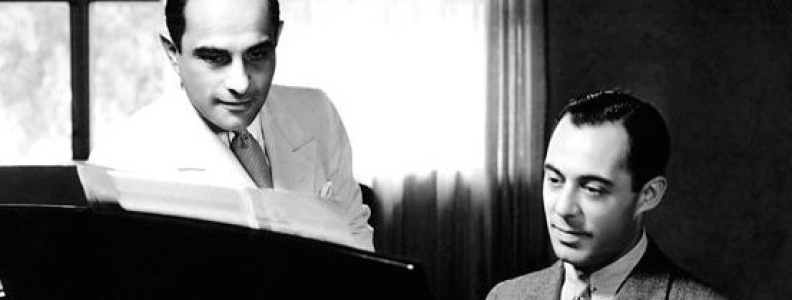
The next movie on our list of Conrad Salinger projects is the biopic of Larry Hart from MGM, entitled Words and Music (1948). Working with Larry Hart proved to be a mixed blessing for Richard Rodgers. Rodgers worked within the confines of a very disciplined regime; he set deadlines for himself, worked hard to meet those deadlines and expected that his collaborators would do the same. In this regard, Hart was a disappointment. Larry was never early with lyrics, forcing Dick to write the music first. Larry rarely was on time to rehearsals, causing Dick to search for him. Larry alternated between periods of great joy and great depression. He drank to excess. He also produced some of the finest lyrics ever to grace the pages of a musical score, and Dick Rodgers loved him dearly.
Rodgers and Hart worked together on Broadway shows from 1920 to 1942. Mary Rodgers, daughter of Richard Rodgers, told the story of her father’s emotional ties to Larry Hart and how he wept in his wife’s arms when Larry passed away in 1943. The movie covers a wide range of the Rodgers and Hart songs, and we have used some of the songs previously in our exploration of Babes in Arms (1937 on Broadway), including “Where or When,” “The Lady Is a Tramp,” “I Wish I Were in Love Again,” “Babes in Arms,” “My Funny Valentine” and “Johnny One-Note.”
We think that many of you will be interested in a 1999 documentary of Rodgers and Hart, about an hour long. It combines historical narration with archival footage of Rodgers and Hart as they worked on Broadway shows and Hollywood musicals. It also has a set of live performances using an on-stage orchestra, original orchestrations and contemporary performers, such as Rebecca Luker and Christine Ebersole. Here is a list of songs with an approximation of time from the start:
- I Fell in Love with Love, near start
- Fly with Me, 6
- A lonely romeo 6:50
- Manhattan, 7:30
- The Girl Friend, 9
- Mountain Greenery, 10
- Thou Swell, 13
- This Funny World, 14
- Dancing on the Ceiling, 16:50
- Love Me Tonight, 18
- Hallelujah, I’m a Bum, 19
- Blue Moon, 19:30
- Jumbo, 20
- On Your Toes, 21
- Egyptian Ballet, 22
- Where or When, 23
- The Lady is a Tramp, 27
- Sing for Your Supper, 30:49
- I Didn’t Know What Time It Was, 35
- Spring is Here, 36:40
- You Musn’t Kick It Around, 40
- I Could Write a Book, 42
- Bewitched, Bothered and Bewildered, 43:26
- Oklahoma, home video, 45,
- To Keep My Love Alive, 47
- My Funny Valentine, 50
For purposes of this post, we decided to focus on one of the best shows created by Rodgers and Hart–A Connecticut Yankee (1927). It was an adaptation by Herb Fields of Mark Twain’s novel, A Connecticut Yankee in King Arthur’s Court. The story concentrates on the adventures of Martin, who is knocked on the head by Fay, his fiancee, and dreams that he is in the Court of King Arthur in 528. While there, he falls in love with Demoiselle Alisande and rescues her from the evil Morgan Le Fay. He awakens to find that he now knows that he loves an old flame, Alice, and not Fay. The key to the success of the musical is the juxtaposition of modern slang into Medieval England, much as was done later with the 1966 James Goldman play, A Lion in Winter. The 1927 musical was a hit and ran for 421 performances; the revival in 1943 carried with it a new song by Rodgers and Hart, “To Keep My Love Alive” (which you can see at minute 47 in the 1999 documentary).
In this part, we are going to concentrate on two songs from the show that went on to be great hits. (In the next part, we are going to concentrate on other Rodgers and Hart songs.)
From the movie, Words and Music, here is June Allyson singing “Thou Swell.”
It is hard to know at this late date how faithful this version by MGM (Lennie Hayton and Conrad Salinger) is to the Broadway original. So, we are also providing Rebecca Luker in a version from a PBS special in 2002.
If we want to look at a recording that was contemporaneous with the Broadway show in 1927, we should compare the previous versions with Ben Slavin’s recording (Franklyn Baur on vocal). It certainly is the strongest of them all.
Now, let’s turn to the second song and one of my Dad’s favorites: “My Heart Stood Still.” Unlike so many of Hart’s lyrics for love songs, this lyric stands out. It captures the impact that love has on us, in that we seem to be functioning–we seem to walking and talking and moving our arms and bodies around; but our mind seems to be stuck in time, closed down, not moving beyond the moment we saw “THE ONE.” Hart substitutes the word “heart” for “mind” in order to convey love.
“My feet could step and walk/My lips could move and talk/And yet my heart stood still.”
This song was not included in the movie, so we are going to use some substitutes. The first one is a recording that states:
“Recorded over two sessions in December 1939 and January 1940, Richard Rodgers conducted a studio orchestra (and performed some piano solos) on this danceable collection of Rodgers & Hart show tunes, presented in the form of eight two-song medleys and issued by Columbia Records as album set C-11 ‘Smash Song Hits by Rodgers & Hart.’ Vocals are handled by Lee Sullivan and Deane Janis.”
The problem is that we are not sure (cannot confirm) that Rodgers conducted these recordings nor played the piano at various times, as indicated. Here is what an expert on Rodgers and Hart would like us to remember, as we listen: these recordings will tell us more about what dance bands sounded like in the 1930s and 40s then what Broadway sounded like in the 1930s and 40s. The arrangements have nothing to do with those that were played in the Broadway pits. And the tempos are all about dance and have little to do with lyrics or the emotional weight a score has to carry on a Broadway stage.
We have been warned; on the other hand, here is a really swinging arrangement of “My Heart Stood Still” and “Thou Swell.” The music was recorded as a medley, in that “Thou Swell” is introduced in the middle of the recording and surrounded at the beginning and the end with music from “My Heart Stood Still.”
In 1943, Frank Sinatra recorded the song; and, while it may not have the tempo or orchestration of the original, Sinatra’s emphasis on the lyric never fails to bring out the true meaning of the song. If anyone can help us with what my friend calls “the emotional weight a score has to carry on Broadway,” it may well be Frank Sinatra.