
Show Boat (1936)–Part Two
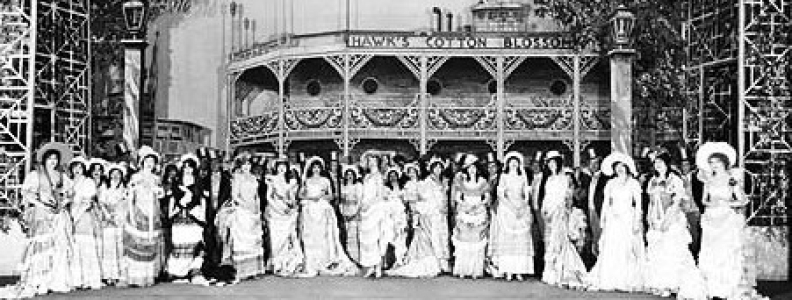
We are going to start off Part Two of our series on Show Boat (1936) with a brief summary of Act One of the 1927 musical. In the late 1880’s, a showboat named “Cotton Blossom,” owned by Captain Andy Hawks and his wife Parthy, plies the Mississippi River as a floating “traveling playhouse,” stopping at various communities to put on musical entertainment and melodramas for the local population. As the “Cotton Blossom” pulls into the dock at Natchez, Mississippi, trouble comes on the double.
First, the engineer, Pete, makes unwanted advances to Julie LaVerne, the leading lady who is married to Steve Baker. When Pete persists, Steve knocks the engineer to the ground. Pete is fired but swears vengeance. Next, we witness a gambler down on his luck, named Gaylord Ravenal , being run out of town (within 24 hours) by Sheriff Vallon. Ravenal hears Hawks’ daughter, Magnolia, playing the piano from the upper deck of the boat and introduces himself. Magnolia is smitten and tells Joe about the stranger. Older and wiser, Joe says that he has seen plenty of gamblers on the Mississippi. Magnolia runs to tell Julie of the flirtation.
It is at this point that Magnolia’s world starts to shatter. Pete swore vengeance and now he returns with the Sheriff to have Julie and Steve arrested for violating Mississippi’s law concerning miscegenation (intermarriage between the races). However, in the few minutes Julie and Steve have before the Sheriff enters the room to confront them, Steve uses a knife to prick Julie’s finger and then drinks her blood, mixing her blood with his. This is enough to turn Steve into a black man and to stop the Sheriff from arresting them; but their careers on the river are now over. Magnolia is broken hearted as Julie and Steve gather up their belongings to leave the showboat for Chicago.
But the “Cotton Blossom” is now without a leading lady and leading man. With almost certain ruin facing the small troupe, Ravenal returns and offers his services as a replacement for Steve (leading man). Grudgingly, Parthy permits Magnolia to take Julie’s part as the leading lady. Before we can catch our breath, Magnolia and Gaylord fall in love, are married and head off for Chicago.
Not only is Act One full of action, it is also full of music. We start with the arrival of the showboat (“Cotton Blossom”); we move to Ravenal’s indifference to the Sheiff’s ultimatum (“Where’s the Mate for Me?”); and then listen to Joe’s lament (“Ol’ Man River”). Without knowing it, Magnolia and Julie spend their last moments together talking about loving one man (“Can’t Help Lovin’ Dat Man”). When Ravenal returns, he clearly sees his new role as leading man on a riverboat as being temporary (“Till Good Luck Comes My Way”); and we hear one of the most haunting pieces of music ever written by Kern (“Mis’ry’s Comin’ Aroun’ “) as underscoring for the bad luck that is still to come. Act One ends on a happy note as Magnolia and Gaylord express their love for each other (“You Are Love”).
The original cast had Norma Terris as Magnolia (replaced by Irene Dunne in the 1936 movie) and Howard Marsh as Gaylord (replaced by Allan Jones); Helen Morgan remained as Julie and Charles Winninger remained as Cap’n Andy. Edna May Oliver (Parthy) was replaced by Helen Westley in the movie, and Jules Bledsoe, who only played Joe on Broadway because Paul Robeson was in London, was replaced by Robeson in the movie. Queenie, Joe’s wife, was played by Tess Gardella on Broadway, but in the movie, Hattie McDaniel played Queenie. Three years later, Ms McDaniel went on to play the role of Mammy in Gone with the Wind, winning an Academy Award for Best Supporting Actress.
We think that the best way to try to explain the staying power of Show Boat is by examining the characters of the four couples. Captain Andy and Parthy have a loveless marriage and are held together only by their love of Magnolia. Queenie and Joe have a strong relationship that comes out more in the movie with the addition of the song, “Ah Still Suits Me.” Gaylord and Magnolia have the opportunity for happiness together, but that happiness is destroyed by his gambling addiction. With Ravenal, as with all gamblers, good luck lies in the next hand of cards or roll of the dice. Sooner or later, the gambler will lose all he loves to his addiction. Finally, the saddest relationship is between Julie and Steve. Any woman of mixed race who tried passing for white lived in mortal fear that the world would learn about her “secret.” Some excellent movies have been made on the subject, such as Imitation of Life or Pinky. If the truth were to come out, the truth would kill. In Julie’s case, Steve leaves her once they arrive in Chicago; she is now alone with no community to call her own. She is not accepted as a black woman; she can no longer pass for white. While we have a much more tolerant view of inter-racial marriages now, Julie had no chance for happiness and ultimately drinks herself to death.
Victor Baravalle was the music director for the Broadway production, where he worked quite closely with the composer, Jerome Kern, and Kern’s favorite orchestrator, Robert Russell Bennett. This musical team was reunited in Hollywood for the 1936 movie. As on the stage, the beauty of the music is reserved for the duets between Gaylord and Magnolia (“Make Believe,” You Are Love” and “Why Do I Love You”). The tragic music is reserved for Julie (“Bill”); the joyful music is given to Julie, Magnolia, Queenie and Joe (“Can’t Help Lovin’ Dat Man”); but the one majestic piece of music is reserved for the philosopher, Joe (“Ol’ Man River”).
Let’s see how the music helped tell the story. We will start by examining “Can’t Help Lovin’ Dat Man” and “Bill.” In Act One, Scene 2, Magnolia starts telling Julie about the strange man who has expressed an interest in her. Julie warns her young friend about riverboat gamblers, to which Magnolia replies with a shrug. Magnolia reasons that, if the man turns out to be no good, Magnolia will just leave him. Julie’s response is quick and accurate–girls like Magnolia don’t leave their man. Julie starts to explain this point of view by singing “Can’t Help Lovin’ Dat Man,” just as Queenie enters. Again, the script foreshadows the coming tragedy; Queenie blurts out that she thought only colored folks knew the song. Eventually, the four characters will sing and dance to the music, Irene Dunne doing her best “chicken walk” or cake walk dance. We, the audience, see at once how close a bond there is between the four people; there is total trust and love in the kitchen. The use of a kitchen as a gathering place in African-American culture is reflected in the stories of Lorraine Johnson-Coleman; if interested, you might want to read “Just Plain Folks.” Many years ago, I heard Lorraine Johnson-Coleman read one of her stories on NPR, and I could feel the warm of the friendships and smell the food cooking on the stove, just as clearly as if I were standing in the room. Take a look for yourselves, as we bring you a video clip from the 1936 movie.
We would also like to illustrate the quality of the singing in this 1936 scene by comparing it to the same number performed by opera singers and led by Frederica von Stade and Jerry Hadley.
Now, we need to switch our attention to “Bill.” In Act Two, Scene Four, Julie is struggling to stay alive by getting singing engagements in bars and clubs. We see her audition for a job, as she sings “Bill” for the owner of the establishment. We think you will want to watch for two things: one, the power that Helen Morgan could get from using very little voice; and the staging of the number, as workers stop what they are doing to listen to Julie break their hearts.
If you have ever wondered what Ava Gardner would have sounded like if they had let her sing the song in the 1952 movie, we can help. Here is “Bill” in Ava’s own voice.
And to finish our comparison with Helen Morgan, here is a clip of the Annette Waren-dubbed version actually heard on the soundtrack of the 1952 movie release.