The Band Wagon–a 1953 Movie
In the first segment of the music of Arthur Schwartz and Howard Dietz, we explored the music from the 1931 Broadway revue, The Band Wagon. Now, we are going to discover how the musical numbers were rearranged and used in a “book” musical that was quite different from the Broadway sketches written by George S. Kaufman and Howard Dietz. Please click on the link to read more and enjoy the music and video clips.
Before we get into the music, we ought to set the stage with some casting information. Fred Astaire, who starred in the 1953 film, also starred with his sister, Adele, in the 1931 Broadway show, the last show that would employ the brother and sister act. Jack Buchanan, who also starred in the 1953 movie, introduced “I See Your Face Before Me” in the 1937 Broadway show, Between the Devil; and Clifton Webb introduced “I Guess I’ll Have to Change My Plan” in the 1929 musical, The Little Show. When Webb was asked to reprise his performance in the movie, he turned it down, because the part of Jeff Cordova was a secondary role. Not every good actor has good instincts. Fred Astaire, hmmm. It seems we have heard that name before.
Frederick Austerlitz was born in Omaha Nebraska in 1899. His older sister, Adele, was a natural dancer and singer; but his mother’s desire to stage a “brother and sister act” fell on deaf ears, because Fred refused to take dance lessons at first, according to Wikipedia. But Fred had fun mimicking his older sister’s dance steps. Fred took up piano, accordion and clarinet. When Fred’s father lost his job at the Storz brewery in Omaha, the family packed up and moved to NYC in 1905 to launch the show business career of the children. At this point, Fred’s mother suggested they change their name to Astaire. Fred’s father became their manager and landed a major contract playing the famed Orpheum Circuit (a vaudeville circuit of Midwestern, Western and Southern cities). However, Adele grew three inches and the children had to wait until Fred caught up. After a two-year hiatus, the siblings started back up, this time incorporating tap dancing into their repertoire. They learned ballroom dancing, such as tango, waltz and foxtrot from another vaudevillian, Aurelio Coccia. But Fred’s dancing was heavily influenced by Bill “Bojangles” Robinson (who we saw in his minstrel dance in King for a Day and in his famous stair dance with Shirley Temple) and John “Bubbles” Sublett (who we cited as the first Sportin’ Life in Gershwin’s Porgy and Bess).
By age 14 (1913), Fred had taken responsibility for the music that he and Adele would use in their act; and three years later, he met a song plugger at Jerome H. Remick’s music publishing house that would change both of their lives. The plugger’s name was George Gershwin.
In 1917, Fred and Adele made it to Broadway in a patriotic revue, Over the Top. By the following year, Heywood Broun went to see The Passing Show of 1918 and wrote: “In an evening in which there was an abundance of good dancing, Fred Astaire stood out… He and his partner, Adele Astaire, made the show pause early in the evening with a beautiful loose-limbed dance.” The two would go on to star in George Gershwin’s Lady, Be Good in 1924 and Funny Face in 1927. They ended their joint career in 1931 with the Schwartz and Dietz show, The Band Wagon. Fred went on to star in his first solo appearance the following year in Cole Porter’s The Gay Divorce (1932).
He went on to star in the movies from 1933 to 1968, when he ended his career in Francis Ford Coppola’s Finian’s Rainbow.
Back to the movie, The Band Wagon. When the movie starts, we see an older Fred Astaire, playing the role of Tony Hunter. Hunter is traveling by train to NY to meet two good friends. We see Tony as the train pulls into Penn Station, NY. He has come in from Hollywood and suddenly realizes that the members of the NY press, while courteous to him, are eager to talk to the newer stars. Tony, like Fred, has retired from show business; and, whether he consciously knows it or not, Tony wants to prove that he is still relevant to the world of performing art.
Fred Astaire played a role that was tailored to his own career. Betty Comden and Adolph Green captured the betrayal that age plays on all of us; neither Tony nor Fred may have felt relevant in 1953. By 1953, tap dancing was a thing of the past; younger performers were being cast in musical adaptations. Color was replacing the black and white mythical kingdoms of the past. Yet, Comden and Green provided us with sufficient characterization to make us understand the emotional vulnerability being experienced by Tony/Fred, and that understanding caused us to side with him. He admitted who he was and what he could do. Comden and Green used Tony’s modesty to compare him to the overblown ego of Jeff Cordova, played to the hilt by Jack Buchanan. There is an initial irony here, because Jack was a London music hall veteran, a “British Fred Astaire.”
The script adeptly alludes to the continuing relevance of Bill Robinson, while it carefully leads us down the path to “high art.” We are sure that the role of Jeff Cordova was a gentle allusion to Leonard Bernstein, who was a good friend of Comden and Green, when the youthful trio were denizens of Greenwich Village. Moreover, Comden and Green modeled the roles of the two writers after themselves, Lily Marton (played by Nanette Fabray) and Lester Marton (played by Oscar Levant).
Comden and Green created artistic tension between Gabrielle Gerard (played by Cyd Charisse) and Tony Hunter by turning her into a prima ballerina. When we examined the work of Eleanor Powell in the Broadway Melody of 1940, we found the same awkward tension in real life occurred between Eleanor and Fred, until they got to know one another. Comden and Green created an excellent script by using real life experiences to blur the line between fiction and fact.
Having acquainted you with the Broadway score in our previous post, we would now like to provide a list of the musical numbers in the movie, as both the numbers and the sequence are different. As Tony arrives in NY, he sings a heartbreaking song to himself, “By Myself.” This song came from the Broadway show, Between the Devil in 1937. He is met at the train station by Lily and Lester, and they let him know that they have thought up a great vehicle for his return to the Broadway stage. This permits the trio to sing “That’s Entertainment.” However, Jeff Cordova wants to cast a ballet dancer, Gabrielle Gerard, opposite Tony, causing Tony a bad case of high anxiety. Lily and Lester take Tony to see Gabrielle dance, at Jeff’s insistence. Cyd performs a beautiful ballet to the music of “The Beggar Waltz.” Tony and Gabby don’t hit it off and are finding reasons to avoid dancing with each other. Finally, they call a truce and get into a horse-drawn carriage to enjoy a peaceful, silent ride through Central Park. The music starts to play “High and Low,” until they get to a spot where there is some dancing. They get out of the carriage and walk over to see what is happening. Their hands cling to one another; and they enter into what can be best described as a “mating dance.” They fall in love to the music of “Dancing in the Dark.”
Jeff’s high brow conception of a new version of Faust has been thoroughly trashed by the critics; and the cast seem to think that they need to start looking for their next audition. No one but Tony shows up at the formal cast dinner, but he leaves immediately. We hear uncredited instrumental music as Fred returns to his room. Two numbers guide him to the cast party/wake: “You and the Night and the Music” from 1934’s show Revenge with Music and “Something to Remember You By” from 1930’s show, Three’s a Crowd. Tony reminisces with the cast about his earlier work, helped out by Lester who starts to sing and play “I Love Louisa” on the piano. The cast joins in. Tony is so carried away with the spirit of the moment that he decides to sell his collection of paintings to finance a new show, the show they were originally going to do. Lily and Lester agree that they can write it; the cast is willing to stay on; even Jeff and Gabby agree to stay and help.
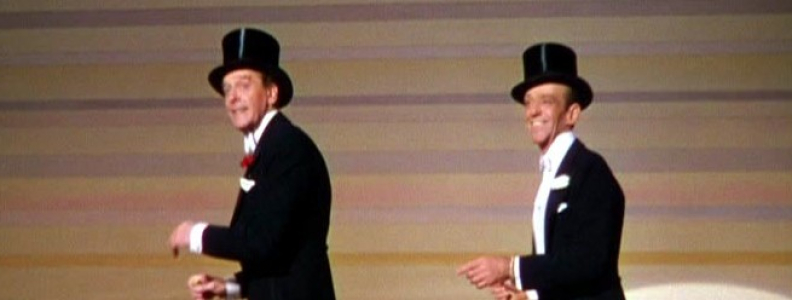
In the new show, Gabby sings and dances to “New Sun in the Sky;” Lily sings “Louisiana Hayride” from 1932’s Flying Colors. Jeff and Tony create a song and dance duet to match the elegance of “I Guess I’ll Have to Change My Plan” from 1929’s revue, The Little Show. Lily, Tony and Jeff dance on their knees in a delicious rendition of “The Triplets” from 1937’s Between the Devil, and the show Tony is producing ends with a great dance routine for Tony and Gabby, called “The Girl Hunt,” written in 1953 for the movie.
Here is the song that got everyone back together again, “I Love Louisa.”
Here is Cyd Charisse performing “New Sun in the Sky” (dubbed by India Adams).
Next, we have Nanette Fabray performing “Louisiana Hayride.”
Finally, we have the duet for Fred and Jack, “I Guess I’ll Have to Change My Plan.”
We will finish the musical numbers in the next post.