
The Corner of Gershwin and Vine
As we said when we started this series of posts about the orchestrations and arrangements of Conrad Salinger, it is sometimes very hard for an audience to understand just what an orchestrator does; we have covered this subject in depth in the website Segment on orchestrators; however, that Segment is more focused on our Broadway orchestrators. While the same principles apply to Hollywood orchestrators, there are differences. One of the biggest differences between the Broadway stage and the silver screen is “distance.” The stage is far away, and the audience must follow what happens onstage from stage right to stage left. While the use of lighting can help to guide the audience from a wide view to one singer in the spot light, the screen uses a much more intimate technique–the close up.
An example is the song “But Not For Me” from the movie version of Girl Crazy. Judy is being chased by all the men, but she does not believe that she will ever find love. In a carefully staged confession to a seated Rags Ragland, almost like a Shakespearean soliloquy, she shares her feelings with the audience. Note Salinger’s careful choice of strings and winds in the music, as he chooses to highlight the singer and not the orchestra.
Let’s compare the Salinger version with an audio clip from the restored stage version (orchestration by Robert Russell Bennett), sung by Judy Blazer, in the 1990 Roxbury recording of Girl Crazy.
The Broadway orchestration has a brighter sound, while the movie version uses a softer sound to emphasize the intimate nature of the “song as confession.”
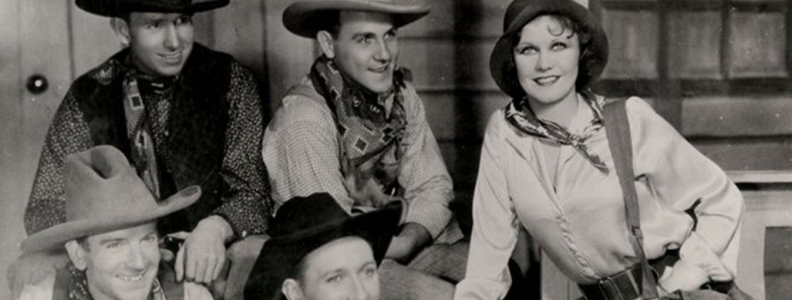
Our featured image is hard to recognize, unless you knew Ginger Rogers before she went to Hollywood (still a teenage here). She is pictured with a male quartet known as The Foursome, who sing “Bidin’ My Time” three times in Act One, almost like a small Greek Chorus. Girl Crazy (1930) was to Broadway what My Man, Godfrey (1936) was to movies–a screwball comedy. In Girl Crazy, a playboy from New York City winds up in Arizona, broke, but still manages to put together in short order a large chorus of professional singers and dancers from Broadway. Today, the show is best known as being the birth place of Ethel Merman, who brought down the house with her rendition of “I Got Rhythm.”
The show also brought forth “Embraceable You,” which we are going share now from the movie.
As you can see, the movie version was set up as a solo for Judy Garland, but the original song on Broadway called for a duet between Boy and Girl, Danny Churchill and Molly Gray. Not only was it a duet, it was a Robert Russell Bennett duet; we are going to provide an audio clip from the Roxbury Recordings version from 1990, with David Carroll as Danny and Judy Blazer as Molly.
When the duet comes to the orchestral interlude, you can clearly hear orchestra launch into the brighter, jazz version that was written for the stage.
Here is some black and white footage of Ethel Merman in 1931, the year following the opening of Girl Crazy on Broadway, singing “I Got Rhythm” during a benefit concert.
Finally, we have the irrepressible Mickey Rooney, trying to woo a very distant Judy Garland, in the movie version of “Could You Use Me?”
And the Roxbury restoration version, with David Carroll and Judy Blazer.