
The Impact On Paul Robeson–Part Four
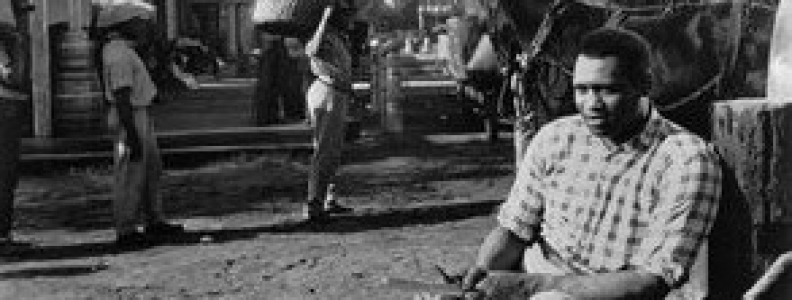
In this fourth post, we are going to focus on Paul Robeson. To say I am impressed by this man would be akin to saying that the Grand Canyon has a pleasant view of the valley below.
While spirituals were traditionally sung in church, the first concert style performance was borne out of necessity. According to David Ewen, George L. White, the Treasurer of Fisk University in Nashville, Tennessee, had a financial hole to fill and decided that all people “might be interested in the poignant music of his race.” Therefore, he formed a choral group of 12 students (the “Jubilee Singers”) and started to tour in October 1871. While it took a while for the concerts to catch on, once they did, the result was historic. “At the Gilmore Music Festival in Boston in 1872, an audience of some 20,000 rose to its feet and shouted: ‘Jubilee Forever!’ When the Jubilee Singers returned to Fisk University in 1878, they returned with over $150,000 in cash.”
In general, the popularity of this music waned until the 1920’s when interest in the music increased as a result of a movement that came to be known as the Harlem Renaissance. Starting in April 1925, Paul Robeson and his pianist, Lawrence Brown, created a sensation in New York City by staging a concert of Negro Spirituals in Greenwich Village. The first was on April 19, 1925, followed by two more concerts—one in Greenwich Village and the second at the 48th Street Theatre. On the list of songs sung at these recitals was “Go Down, Moses.” They went on tour but returned to New York to give two concerts at the Comedy Theatre, the first on November 14, 1926 and the second on December 5, 1926.
Who was this Paul Robeson? He was a 1919 graduation of Rutgers and only the third African American to attend the school. He competed in four sports and earned All-American honors as a tight end in football in 1917 and 1918. He was elected to Phi Beta Kappa and Cap and Skull and was named by his class as valedictorian. He went on to study law and graduated from Columbia Law School in 1923, while supporting himself outside the classroom by playing in the NFL and singing and acting in New York City.
During an interview, Paul explained that it was not easy to get his white teammates to accept him on the football team when he first tried out. They played rough and broke his nose. He decided to fight back; and because of his toughness on the field, his fierce desire to win and his unquestioned ability, he forced his white teammates to accept him as an equal.
He was not as persuasive in his law practice. After graduation from Columbia Law School and passing the bar, he was hired by a New York City law firm. The firm had to let him go because their clients (white) refused to have a black lawyer attend to their legal matters.
Of course, the end of his legal career coincided with the beginning of his acting career. In 1923, he was asked by Eugene O’Neill to act in Emperor Jones. At first Robeson laughed at the idea but then consented to play the role. After this, in 1924, he starred as Jim in O’Neill’s All God’s Chillun Got Wings.
Paul played Joe in the London production of Show Boat in 1928; then starred as Othello opposite Peggy Ashcroft in a West End production in 1930. He went on to play Joe in the 1936 film version of Show Boat and was the first African-American to play Othello on Broadway with a white supporting cast (1943).
No other actor has been so clearly identified with one song as Robeson has been with “Ol’ Man River.” This is not by happenstance; it was decreed the day that Kern and Hammerstein wrote the song for Paul.
“There is no definitive evidence that Kern and Hammerstein attended any of Robeson’s concerts. However, it is clear from the detailed information uncovered by Todd Decker in his book, Show Boat, Performing Race in an American Musical, that the two men knew of Robeson, intended that Robeson play the role of Joe in the musical and wrote “Ol’ Man River” with Paul in mind. According to Todd Decker in his book, Who Should Sing “Ol’ Man River? he states: “The idea for “Ol’ Man River” began with Jerome Kern, who recalled in a letter how ‘Paul Robeson’s speaking voice,’ encountered by Kern in a short-lived play called Black Boy, served as “that thing called inspiration” for the melody of ‘Ol’ Man River.’ ”
As we leave this post, we would like to show you the soft and tender side of both Stephen Foster and Paul Robeson. In one of the last songs ever written by Foster, the lyrics and melody reveal a wistful longing, as the singer hears the voices of dead friends and relatives and knows that he will soon be joining them. Here is Paul’s rendition of “Old Black Joe” also known as “Gone Are the Days.”