
The Music Man–Tony Winner for Meredith Willson
When we studied the works of Leonard Bernstein a few months ago, we ended with his immortal score for West Side Story. West Side Story was nominated for Best Musical in 1957, but lost to The Music Man. If we focus solely on the score for each musical, we wouldn’t hesitate for a moment. We would pick West Side Story. But the award for the best musical includes an evaluation of both the libretto and the music. West Side Story is dark and contains an ending that is at odds with the rest of the script, as we pointed out previously. On the other hand, the libretto for The Music Man is engaging, sly at times, surprisingly optimistic and eventually up-lifting. The score matches the libretto, is bright and effective and uses a number of skilled techniques in order to provide the audience with a substantive experience, perhaps more substantive than is warranted.
Meredith Willson was an excellent composer who received an Academy Award nomination for Best Original Score for Charlie Chaplin’s The Great Dictator (1940); he also wrote the score for the musical The Unsinkable Molly Brown (1960) and wrote scores for two symphonies and a number of minor, symphonic works. Yet, we remember his best for his score for The Music Man, which was varied and imaginative, rather than classically dramatic.
The story is not terrible complicated. In the very first scene we learn that Prof. Harold Hill is a con man who convinces parents to buy fancy uniforms and instruments for a boys’ band, on the understanding that Hill will teach them how to play their instruments. Of course, he has no ability as a musician and leaves town before the townspeople find out that he has perpetrated a hoax. Coming into River City, Iowa, he intends to repeat his con game by convincing the parents that the boys of the town will become juvenile delinquents unless they form a boys’ band (“Ya Got Trouble”). The problem for him is that he falls in love with the town librarian and wants to stay. As in all fairy tales, somehow the kids are able to play well enough on their own to save him, the band and the musical. While none of us in the audience really believe (with our minds) that the boys could actually play their instruments, we all hope (with our hearts) that a miracle will occur.
We like Harold Hill; we like the music. After all, the original cast score won a Grammy and spent 245 weeks on the Billboard charts.
The opening number provides us with all we needed to know about Prof. Harold Hill and the story line of the musical. What holds our attention after the opening number are the roadblocks put up to try to thwart Hill’s plan and how he weaves his way around them.
The opening number originally had music, but the music was dropped during tryouts. What we hear is a spoken song that is shouted/sung to the rhythm of the train, leaving the station, moving at full speed and then slowing down as it enters the next station. It is an ingenious way to frame the plot and the character of the leading man. Here is “Rock Island” from the movie.
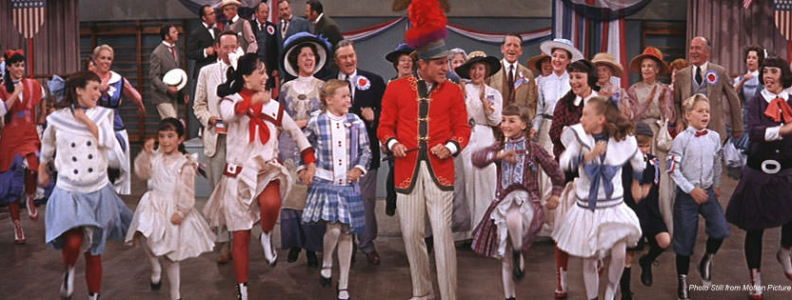
Of course, the entire show revolves around Hill’s ability to “manufacture” a crisis that will necessitate the creation of a boys’ band. Robert Preston is as good as Rex Harrison would be in My Fair Lady, as Preston talks in rhythm, while the crowd carries the melody for “Ya Got Trouble.” We all know the words, “with a capital T and it rhymes with P and it stands for pool. Right here in River City.” What we really have, if we stand back for a moment and watch the “preacher” in front of the “congregation” facing him, is a good old-fashioned revival meeting, complete with the preacher moving through the crowd to the waving of the arms of the congregation. All that is missing is the tent. Here is Robert Preston, in the movie, who reprises his role from the musical.
Having created the illusion of pending doom, Hill now presents his answer: a boys’ band. Here we have a clip from the Tony Awards, where the 2000 revival with Craig Bierko and Rebecca Luker captures the excitement of the original 1957 show with a stirring rendition of “76 Trombones.”