Vaudeville Reborn in Movies
If the real life Gallagher and Shean vaudeville team could be recreated for the movie, Ziegfeld Girl, in 1941, the studios wondered if the public might like to see how vaudeville performers created routines on the circuits. Let’s consider another vaudeville team, the team of Weber and Fields. Contrary to the Wikipedia speculation about Gallagher and Shean, Joe Weber and Lew Fields, two successful vaudeville performers, may have served as the factual basis for the 1972 play and the 1975 movie, The Sunshine Boys. Weber and Fields had great success with their “Dutch” act before deciding in 1896 to open their own theater in New York, called the Weber and Fields Music Hall. In burlesques, such as Pousse Café/The Worst Born (1897), Hurly-Burly (1898), Whirl-I-Gig (1899), Fiddle-Dee-Dee (1900), Hoity-Toity (1901), Twirly-Whirly (1902), Whoop-Dee-Doo (1903) and Roly Poly (1912), Weber and Fields produced the show for their Music Hall and performed in the show. At the very least, they would collect their pay as performers.
The less successful vaudevillians had to hone their craft touring one or more of the “circuits,” sets of theaters booking vaudeville acts from the New York office. In an interview for a PBS special production concerning vaudeville and its performers, Donald O’Connor, a man we studied in the last month or so, made the point that performers with a successful routine did not dare change the act. Customers who had seen the act in the previous year would come back the next year to see the act with their friends. Everyone expected to see the same act (just as we expect to see the same content every time we play a DVD); and if the performer didn’t provide a carbon copy of the original, the performer would be booed off the stage.
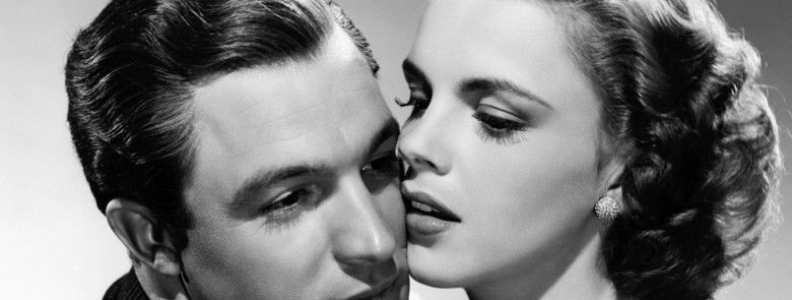
In the movie, For Me and My Gal (1942), MGM put together a familiar plot in order to present a bunch of great Tin Pan Alley songs, as sung and danced by Gene Kelly, Judy Garland and George Murphy. The songs we have chosen were composed by ragtime songwriters and provide an illustration of how Scott Joplin’s piano rags were translated into ragtime love songs. Talking about Joplin, let ‘s listen to his “The Entertainer” from 1902 (piano roll).
Now, let’s listen to how Chris Smith, a ragtime composer, used ragtime piano music as his base model when he composed “Ballin’ the Jack” in 1913. While the syncopation may remain dominant, it is not offset by the use of a march in the left hand on a piano.
Next, we see a performance of Percy Wenrich’s song, “When You Wore a Tulip and I Wore a Big Red Rose.” He wrote this in 1914.
This takes us to a wonderful medley started by George Murphy as a solo; then the choreographer used an old trick of a “wind-up toy” in order to create a play on words–Judy Garland is a wind up doll, as she sings and dances a duet with Murphy to the Nat Ayers 1911 tune, “Oh, You Beautiful Doll.” The same technique was successfully used in 1968 in the Dick Van Dyke movie, Chitty Chitty Bang Bang.
Finally, we come to the title song of the movie, featuring George W. Meyer’s 1917 ragtime love song, “For Me and My Gal.”