Victor Herbert’s Humor Lives On–Broadway’s Golden Era
We were planning to move from parody to tender lullabies in Babes in Toyland, but… Another idea came to mind. Why don’t we use the last two posts as a way of demonstrating how the model of parody and humor stayed vibrant and current on Broadway forty years after Babes in Toyland opened on Broadway (1903).
In their splendid book, Changing Stages, A view of British and American Theatre in the Twentieth Century, Richard Eyre and Nicholas Wright said:
“If we take for granted now that a musical can fuse dialogue, song and dance in the service of dramatic narrative, it is because Rodgers and Hammerstein made it seem as inevitable and necessary as the invention of television. They changed the course of American musical theatre just as Chekhov and Ibsen changed the course of twentieth-century drama: in both cases transforming existing forms by embracing real issues, and examining real characters and situations.
“In the case of the musical, an apparently endemically frivolous medium became a vehicle for serious situations and profound passions. The musical grew up. What had been fitfully attempted in Showboat became triumphantly achieved: a seamlessly unified depiction of narrative and character through dialogue, song and dance.
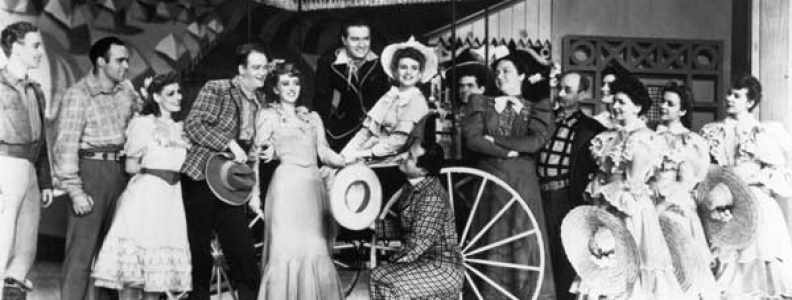
“Rodgers and Hammerstein’s first collaboration, Oklahoma!, emerged from a play that was performed unsuccessfully in 1931. It was by a writer who specialized in cowboy subjects; he was part Cherokee and grew up in Oklahoma. His name was Lynn Riggs and his play was Green Grow the Lilacs.”
Continuing: “The show . . . [was] set in the Midwest at a time when America was still defining itself and still busy creating its own legends about its past. It opened in wartime—and offered up a world in which the important feuds were between cowmen and farmers, rather than between fascism and democracy.
“What made Oklahoma! remarkable was that it stubbornly refused to deal with Broadway in its own currency: ‘No gags, no girls, no chance’ was the word on the street before it opened. It wasn’t about show-business or society people; it wasn’t formulaic; it didn’t relentlessly attempt to manipulate the audience’s feelings; it was about very ordinary people and loneliness and unhappiness—and of course about falling in love. What it did, it did with huge conviction and energy, and where Showboat was elephantine in its epic narrative, Oklahoma! had a fleet-footedness in its story-telling, aided by the use of dance—a dream ballet—as a device for advancing the plot rather than diverting attention from it.”
And yet, and yet, Oklahoma! (1943) is filled with just the kind of “laugh-out-loud” humor that we saw in Babes in Toyland.
In the song, “The Farmer and the Cowman,” Oscar Hammerstein II was able to blend the serious difficulties encountered by ranchers, who needed open range for their cattle, and farmers, who needed fences to keep animals away from the crops they were planting and growing. Yet, the humor just managed to keep a hoedown from becoming a brawl.
Carnes: The farmer is a good and trusty citizen/No matter what the cowman says or thinks/You seldom see him drinkin’ in a barroom–
Curly: Unless somebody else is buying drinks.
Aunt Eller: I’d like to say a word for the cowboy/The road he treads is difficult and stony/He rides for days on end/With just a pony for a friend
Ado Annie: I sure am feelin’ sorry for the pony.
Aunt Eller: The farmer should be sociable with the cowboy/If he rides by and asks for food and water/Don’t treat him like a louse/Make him welcome in your house
Carnes: But be sure that you lock up your wife and daughter.
Let’s listen to the cast of the movie sing this song:
The humor of parody was never on better display than in the mock “funeral” outlined by Curly as he tries to persuade Jud, the hired hand, to hang himself. Curly imagines what Jud’s funeral would be like, how people would come from all over. “They would. You never know how many people like you till you are dead.” Jud asks whether there would be any flowers. “Sure would, and palms too.”
Curly observes that women would weep and faint, ones that had taken a shine to Jud. When Jud asks what women took a shine to him, Curly responds “Lots of women. Only they don’t never come right out and show you how they feel unless you die first.”
When they start to sing this great duet, “Poor Jud,” Curly points out: “He’s all laid out to rest/With his hands across his chest/His fingernails have never been so clean.”
Later in the lyric, Curly explains what will happen when Jud is buried: “The daisies in the dell/Will give off a different smell/Because poor Jud is underneath the ground.”
The best of Curly’s observations is saved for last: “He looks like he’s asleep/It’s a shame that he won’t keep/But it’s summer and we’re runnin’ out of ice.”
Let’s listen to this wonderful parody, sung by Gordon MacRae and Rod Steiger:
The same type of parody was used most effectively in Brigadoon by Alan J. Lerner, when he wrote the lyrics for “My Mother’s Wedding Day.”
MEG:
Now if ye think this weddin’ day went jus’ a wee amiss,
Then I will tell ye ’bout a weddin’ far more daft than this.
The lad involved turned out to be no other but my pa,
An’ by the strangest bit o’ luck,
the woman was my ma.
MacGregor, MacKenna, MacGowan, MacGraw, MacVitie, MacNeil an’ MacRae;
Ay, all the folk in the village were there at my mother’s weddin’ day.
For pa had asked his friend MacPhee,
an’ Mac had come with May MacGee,
An’ May invited ninety-three to my mother’s weddin’ day.
Then up the road came Ed macKeen with half the town of Aberdeen.
CHORUS:
Ay, ev’ryone was on the scene at her mother’s weddin’ day.
MEG:
At quarter to five everybody was there a-waitin’ around in the room,
MacVicker, MacDougall, MacDuff an’ MacCoy–everybody but the groom.
An’ as the hours turtled by, the men got feelin’ kind o’ dry,
An’ thought they’d take a nip of rye while a-waitin’ for the groom.
An’ while the men were dippin’ in, the ladies started on the gin.
CHORUS:
An’ soon the room began to spin at her mother’s weddin’ day.
MEG:
Then all of a sudden the liquor was gone, the gin an’ the whiskey an’ all.
An’ all of a sudden the weddin’ affair had become a bonnie brawl.
For Pete MacGraw and Joe MacPhee began to fight for May MacGee,
While May MacGee an’ Sam MacKee were a-wooin’ in the hall.
So cold an’ stiff was John MacVay, they used him for a servin’ tray.
CHORUS:
For ev’ryone was blithe and gay at her mother’s weddin’ day.
MEG:
MacDuff an’ MacVitie were playin’ a game, an’ usin’ MacCoy for the ball.
MacKenna was eatin’ the bridal bouquet, an’ MacNeil hung on the wall.
When finally my father came, his eyes were red, his nose aflame.
He dinna even know his name; he was drunkest of them all.
The people were lyin’ all over the room a’lookin’ as if they were dead,
Then mother uncovered the minister quick, an’ she told ‘im: Go ahead.
Then pa kneeled down on Bill MacRae, an’ mother kneeled on Jock MacKay,
The preacher stood on John MacVay, and that’s how my ma was wed.
It was a sight beyond compare. I ought to know, for I was there.
CHORUS:
There never was a day as rare as her mother’s weddin’ day!
Let’s listen to Susan Johnson from a 1958 recording: