
West Side Story–An Overview of Leonard Bernstein’s Masterpiece
We are about to start a series of posts to discuss and listen to music from one of the greatest scores ever to be written for Broadway—West Side Story. If you click on the link, below, you can listen to some amazing audio and video clips from the original cast. In later posts, we will highlight clips from Leonard Bernstein’s one and only time conducting the score.
The show we know and love opened on Broadway in 1957, ran for only 732 performances and lost the Best Musical Tony to The Music Man. In 1961, the movie of West Side Story was released and has received a better reception, right down to today. There is a reason for the show’s lack of acceptance on Broadway in 1957.
The Broadway show was dark and unforgiving; it told the story of Romeo and Juliet, without the benefit of Shakespeare’s brilliant iambic pentameter. Both plots present two warring families/gangs—Jets and Sharks. At a dance, Romeo/Tony sees Juliet/Maria and falls in love. They declare their love on her balcony, but from that point on, everything goes terribly wrong. In the musical, a rumble (fight) turns into murder, as Bernardo, head of the Sharks, kills Riff, leader of the Jets. In revenge, Tony (Riff’s life-long friend) stabs Bernardo, Maria’s brother.
Maria understands that Tony went to stop the fight and that what unfolded was not his fault. She still loves Tony and tries to find a way to keep him safe, because Chino, a Shark, is looking to shoot Tony and avenge Bernardo’s death. Finally, Anita (who had been in love with Bernardo) agrees to warn Tony for Maria’s sake. But she is roughed up by some of the Jets and tells them that Chino has killed Maria. Tony, no longer caring if he lives or dies, goes out into the streets, finds Maria, who is very much alive, and goes to her, just as Chino arrives and shoots Tony. It is a sad ending, without providing much hope that any of the major questions raised in the course of the evening will be solved.
Shakespeare understood this; his play centered on a feud between two families. The elders of those families had the power at any time to end the feud; there was no fundamental issue separating them, other than personal pride. Thus, at the end, the head of each family could emotionally feel the loss of a beloved family member, a loss that could have been prevented, a loss that was caused for no good reason, a loss that was almost avoided because of a love that attempted to bridge the artificial divide. Their common loss causes the heads of both families to understand the urgent need to end enmity and bitterness and replace those emotions with respect and affection.
In West Side Story, Tony’s life might have served the purpose of bringing mutual respect and peace to the members of the two gangs; his death only served to provide a temporary truce to the clash of cultures, both of whom still felt betrayed by mainstream American society. Nevertheless, it is what it is; and we must take the show as we find it. In reflection, it is clear that The Music Man won the Tony because Broadway was not ready for a “newsprint” musical. The concept of gangs in New York City was taken from an article in a newspaper about gang warfare in Chicago. Thus, the show was the forerunner of the shows that would follow—shows that highlight the gritty reality of American life without providing any tangible hope for a better tomorrow.
The perception that the book for West Side Story had flaws most probably stemmed from the start-and-stop nature of its development. Ten years before the show opened (in 1947), Jerome Robbins came up with an idea about turning Romeo and Juliet into a musical. According to Wikipedia, Robbins proposed that the plot focus on the conflict between an Irish Catholic family and a Jewish family during the Easter-Passover season in the lower east side of Manhattan. Robbins took the project to Leonard Bernstein and Arthur Laurents. Laurents immediately started to work on the libretto, calling it East Side Story. When the three men reviewed the draft, they felt that it was just a re-hash of Abie’s Irish Rose, and the project was shelved for five years.
In the mid-50’s Laurents and Bernstein decided to update their concept and to switch the focus of the story from an old religious conflict to the new world of juvenile gang warfare. They got a young Stephen Sondheim to write the lyrics, and West Side Story started to take on form. The biggest change revolved around the music for “One Hand, One Heart.” Originally intended for Cunegonde in Candide, the collaborators convinced Bernstein to move the song into West Side Story. Initially, “One Hand, One Heart” was intended for the balcony scene; however, Oscar Hammerstein II and Arthur Laurents convinced Bernstein and Sondheim to move the song to the bridal shop where Maria worked. In its place, Bernstein wrote “Tonight” for the balcony scene.
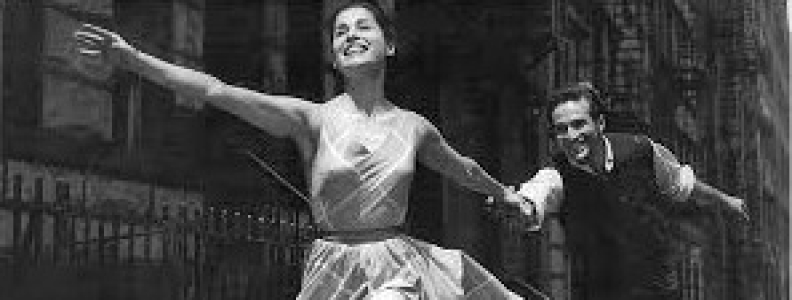
Luckily, the casting for West Side Story was incredibly good. Larry Kert, Carol Lawrence and Chita Rivera had the voices and dancing skills needed to play the roles of Tony, Maria and Anita, respectively. When we look at the more recent recordings, we realize the how fortunate we were to have such exceptional voices in the cast in 1957. Today, we see only those voices trained for opera as being able to handle these demanding roles.
The music is excellent and still very popular. Alas, we have limited time, as do you, so we are going to emphasize most but not all of the songs. At the same time, we have some wonderful surprises for you.
The first surprise revolves around the Overture from the original cast album; however, in this clip we see original pictures of the cast and creators. It is a wonderful slide show of people and memories from sixty years ago.
The second surprise is a 25-minute recreation by David Fletcher that starts with archived footage from home movies and the Ed Sullivan television show. While the Ed Sullivan tapes stand on their own (black and white), Fletcher sync’d original cast music to the home movies (mostly in color), so we can see and hear the cast singing and dancing to numbers, such as “Cool,” “One Hand, One Heart,” “I Feel Pretty,” “Somewhere,” and the brilliant duet “A Boy Like That/ I Have a Love.” There is no other source that we know of that can provide this type of experience.