Yankee Doodle Dandy–Part Two
The casting of the lead role took a number of turns before Jimmy Cagney landed the role. George M. Cohan had preferred that the role be played by Fred Astaire; however, according to Wikipedia, “Astaire turned it down because Cohan’s eccentric, stiff-legged dancing was far removed from Astaire’s own, more fluid, style.” Cagney was initially opposed to portraying Cohan because of George’s opposition to the Actors’ Equity strike in 1919. However, “In 1940, Cagney was named, along with 15 other Hollywood figures, in the grand jury testimony of John R. Leech, the self-described ‘chief functionary’ of the Los Angeles Communist Party.” Cagney denied this and his denial was corroborated by Martin Dies, Jr., the Texas Democrat and first Chairman of the House Special Committee to Investigate Un-American Activities.
Notwithstanding the facts, Cagney’s reputation had been tarnished. Again, according to Wikipedia “William Cagney, one the the film’s producers, is reported to have said to his brother that ‘we’re going to have to make the goddamndest patriotic picture that’s ever been made. I think it’s the Cohan story.’ ” We remain convinced that whatever reservations Cagney may have had about Cohan did not extend to reservations about America. On December 7, 1941, the Japanese attacked Pearl Harbor; and shortly thereafter, Congress declared war on Japan. Jimmy Cagney supported the war effort by making a movie that motivated everyone to do their part. No one could see the New York premiere unless they had bought war bonds. His support of FDR in the movie further solidified the attitude of ordinary citizens to rally around the President and the war effort.
While we may never know all of the thinking that went into the decision, once Jimmy decided to take the role, he put his considerable energy into mastering the song and dance techniques used by Cohan in the original productions on Broadway of Little Johnny Jones (1904), Forty-Five Minutes from Broadway (1906) and George Washington, Jr. (1906). Moreover, according to Wikipedia, “care was taken to make the sets, costumes, and dance steps match the original stage presentations. Twice, Cagney sprained an ankle while mastering Cohan’s stiff-legged dance style. This effort was aided significantly by a former associate of Cohan’s, Jack Boyle, who knew the original productions well. Boyle also appeared in the film in some of the dancing groups.”
Because the movie is told in chronological order, we will present the music in the same way. The first song is in the form of a video clip from the movie, featuring The Four Cohans singing and dancing to George’s tune, “I Was Born in Virginia.”
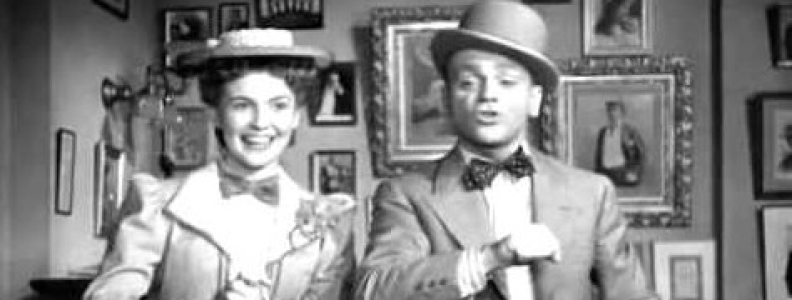
While a little out of order, we next see Jimmy Cagney and Joan Leslie pitching the song, Harrigan, to Broadway producers. Actually, the song came out of Cohan’s 1907 hit, Fifty Miles from Boston.
Next, we come to Cohan’s first major Broadway success, Little Johnny Jones. The plot is a rather typical melodrama about an American jockey, wrongfully accused of fixing a horse race, who is eventually shown to be innocent. On the other hand, the show has given us two songs that remain as famous today as they were in 1904. The first is the production number, “The Yankee Doodle Boy.” Joan Leslie’s voice is dubbed by Sally Sweetland.
The second song is the immortal “Give My Regards to Broadway.”
We will finish our look at Little Johnny Jones in the next post.