

Yankee Doodle Dandy–The Life and Times of George M. Cohan
We want to spend some time getting to know the great movie musical, Yankee Doodle Dandy. It was released by Warner Brothers in 1942; and this classic has become one of those movies that always seems relevant, new and fresh, just like the music featured in the movie–the compositions of George M. Cohan. However, before we can understand the movie, we first need to understand the character of the man immortalized in the movie.
Cohan has been described in many ways, but he was never described as being an easy-going, get-along type of guy. From his earliest days, he was impatient, sure of himself and his talent and bent on success. He played fair, but he also played to win. Just like his characters, he was brash and cock-sure. He used slang that would resonate with working class men but not offend women. He put America first and would fight any man who said otherwise. He wrapped himself in the flag and used his love of country as the basis for his musicals.
Cohan was born on July 3, 1878 and was a great American entertainer, playwright, composer, lyricist, actor, singer, dancer and producer. Cohan began his career as a child, performing with his parents and sister in a vaudeville act known as “The Four Cohans.”
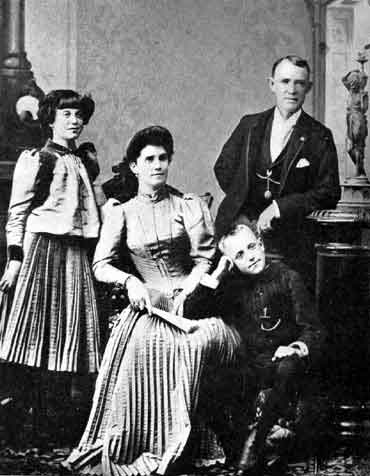
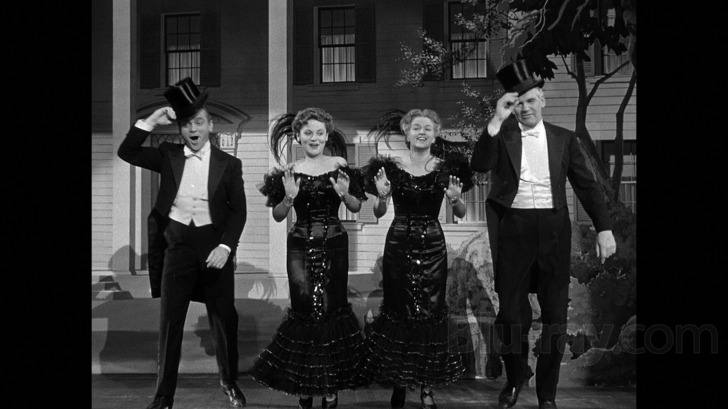
Now that we have shown the portrait of the actual family, here is a picture of the movie family.
Cohan’s shows followed a pattern: he would write the libretto, compose the score, produce (at first with Sam Harris, his partner) and act in more than three dozen Broadway musicals. Little Johnny Jones (1904), his first big Broadway hit, provided Cohan the opportunity to introduce such American standards as “The Yankee Doodle Boy” and “Give My Regards to Broadway.”
As a composer, he was one of the early members of the ASCAP. Cohan became one of the leading Tin Pan Alley songwriters, publishing upwards of 300 original songs, noted for their catchy melodies and clever lyrics that used snappy American slang. His major hit songs included “You’re a Grand Old Flag,” “Forty-Five Minutes from Broadway,” “Mary Is a Grand Old Name,” “The Warmest Baby in the Bunch,” “Life’s a Funny Proposition After All,” “I Want To Hear a Yankee Doodle Tune,” “You Won’t Do Any Business If You Haven’t Got a Band,” “The Small Town Gal,” “I’m Mighty Glad I’m Living, That’s All,” “That Haunting Melody,” “Always Leave Them Laughing When You Say Goodbye,” and America’s most popular World War I song “Over There,” which was recorded by Enrico Caruso among others.
In 1925, he published his autobiography, Twenty Years on Broadway and the Years It Took to Get There.
Known in the decade before WWI as “the man who owned Broadway,” he is considered an innovator in the development of American musical theatre by bringing melodrama to the Broadway musical. He became an early pioneer in the development of the “book musical,” using his engaging libretti to bridge the gaps between drama and music. More than three decades before Agnes de Mille choreographed Oklahoma!, Cohan used dance to advance the plot. Cohan’s main characters were average Americans that appealed to a wide American audience.
Cohan wrote a song called “You Won’t Do Any Business (If You Haven’t Got a Band).” The title refers to the old form of advertising a traveling show. Prior to the opening of a new show, the producers would hire a local band, which would proceed to march through the town, playing songs from the newly arriving show. If you tried to cut costs and didn’t hire a band, the seats of the theatre would be empty. Here is Cohan singing the song in a 1911 recording, along with his version of another of his tunes, “I Want to Hear a Yankee Doodle Tune.”
Cohan earned acclaim as a serious actor in Eugene O’Neill’s only comedy, Ah, Wilderness! (1933), and in the role of President Franklin D. Roosevelt in Rodgers and Hart‘s musical I’d Rather Be Right (1937). In 1940, Judy Garland played the title role in a film version of his 1922 musical Little Nellie Kelly.
In his New York Times obituary, Cohan was called “the greatest single figure the American theatre ever produced – as a player, playwright, actor, composer and producer.” On June 29, 1936, President Roosevelt presented him with the Congressional Gold Medal for his contributions to WWI morale, in particular the songs “You’re a Grand Old Flag” and “Over There.” Cohan was the first person in any artistic field selected for this honor.
Cohan’s life and music were depicted in the academy-award winning film Yankee Doodle Dandy (1942) and in the 1968 Broadway musical George M! A statue of Cohan in Times Square in New York City commemorates his contributions to American musical theatre. He was inducted into the Songwriters Hall of Fame in 1970, and into the American Folklore Hall of Fame in 2003. He has a star on the Hollywood Walk of Fame.
We are going to close with another recording of a Cohan tune, this time George’s version of “The Small Town Gal” from his show Fifty Miles from Boston. In the next post, we will start by discussing the movie and its star, Jimmy Cagney.